

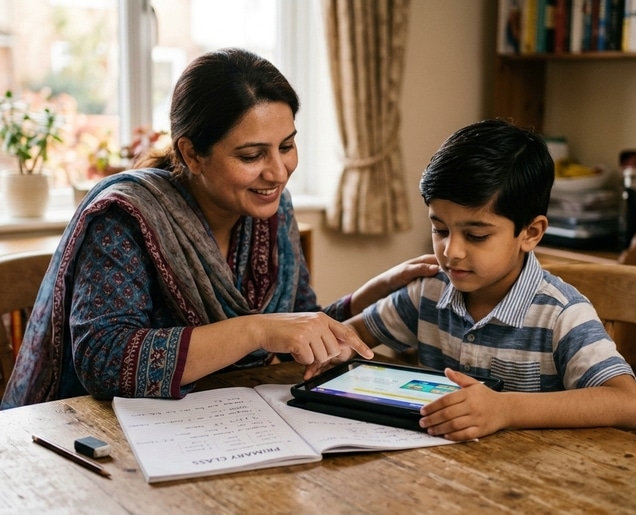
If you have had an argument about a phone or tablet with your child this week, you are in the majority. Screen time for kids has become one of the most common sources of conflict in Pakistani homes, and Lahore families are no exception. The challenge is real, the devices are everywhere, and the guidance available to parents is often either too strict to be practical or too vague to be useful. This guide gives you honest, research-based information and a workable approach.
Why Screen Time Arguments Have Replaced Homework Battles at Home
A decade ago, homework was the primary source of daily conflict for parents of primary-school children. Today, screens have taken that position — and the conflict often begins the moment a child walks through the door. The reason arguments happen is not simply that children love screens. It is that screens are genuinely designed to be compelling, are immediately available, and have no natural stopping points built in for young children. Without a clear structure, conflict is almost guaranteed.
What Research Actually Says About Screen Time for Ages 6–11
The most cited guidance comes from the WHO (World Health Organization), which recommends limiting sedentary recreational screen time for children. For children aged six to eleven, the research indicates that more than two hours of recreational screen time per day is associated with reduced physical activity, poorer sleep quality, lower academic performance, and reduced attention span. Importantly, the research also distinguishes between types of screen use — passive consumption is more harmful than interactive or educational use.
Not All Screens Are Equal — Learning Apps vs. Passive YouTube
There is a meaningful difference between a child spending forty minutes on a structured learning app and a child spending forty minutes watching YouTube videos. Educational technology used in a focused, intentional way has genuine benefits. Passive video consumption, especially algorithm-driven content that auto-plays endlessly, is the category that research consistently links to attention and sleep problems. When assessing your child’s screen time, look at what they are actually doing on the screen, not just how long they are on it.
The Pakistani Reality: Shared Devices, Online Classes, and Boredom
Setting screen time rules in Lahore comes with specific local challenges. Many households share devices between siblings and for different purposes — homework, recreation, and online classes all happen on the same tablet. Children whose parents work long hours may have more unsupervised screen access. Extended family members may not agree on rules. Any screen time approach that does not account for these realities will not last more than a week. Solutions need to be practical, not just principled.
How to Set Screen Time Rules Your Child Will Actually Respect
Rules that are created with a child are more likely to be followed than rules handed down without explanation. Sit with your child and agree on:
- A daily screen time allowance for recreational use — one to one-and-a-half hours is realistic for most families.
- When screen time is available — after homework and outdoor time, not before.
- Which content is allowed — agree on platforms and content types in advance.
- A natural stopping point — a timer or an agreed number of episodes, so the end does not feel arbitrary.
What to Replace Screen Time With That Does Not Feel Like Punishment
One of the most common mistakes parents make is removing screens without offering a replacement. Children who are bored will always find a way back to the screen. Alternatives need to be genuinely interesting, not just educational. Physical play, building games, art materials, books with strong stories, cooking with a parent, or visiting a local park all work — but they need to be available and slightly facilitated, especially for younger children who have difficulty initiating unstructured time independently.
Signs Screen Time Is Already Affecting Learning or Sleep
Watch for the following signs that screen use has begun to affect your child:
- Difficulty falling asleep or waking very early — screen light disrupts melatonin production.
- Irritability when screens are taken away that lasts for more than 10 to 15 minutes.
- Declining interest in previously enjoyed activities like drawing, outdoor play, or reading.
- Reduced concentration on schoolwork or homework, taking significantly longer than usual.
A Realistic Screen Time Plan for Busy Lahore Families
A workable daily plan for primary-school children looks like this: no screens during the school morning, limited screen access in the afternoon after homework, and screens off at least 1 hour before bed. Weekend allowances can be slightly more flexible. Revisit and adjust the plan every few months as your child grows and their needs change. The goal is not zero screens — it is intentional screens with clear boundaries and genuine alternatives available.
At ITH School, we integrate technology into learning in purposeful, age-appropriate ways. Reach us via Contact Us or WhatsApp. Follow us on Facebook, Instagram, LinkedIn, and X (Twitter). Visit us at 01 Block A, Chaudhry Road, KCHS Phase 1, Defense Road, Lahore — Location.