
STEAM education for children is one of the most-discussed ideas in modern primary schooling — yet for many parents in Lahore, the acronym still raises more questions than it answers. What does it actually involve at the primary school level? Is it suitable for very young children? And does it produce genuine educational benefits, or is it simply a fashionable term schools use to sound progressive? This article answers those questions honestly, drawing on verified information about how ITH School applies STEAM principles across its programmes every day.
What Does STEAM Stand For?
STEAM stands for Science, Technology, Engineering, Arts, and Mathematics. It evolved from the earlier STEM framework. Educators deliberately added Arts to the model. This addition reflects the role of creative thinking, communication, and design. These skills support scientific and technical problem-solving in real life.
In a STEAM classroom, teachers do not teach these five disciplines as isolated subjects. Instead, they connect them through projects, investigations, and real-world challenges. These activities encourage children to use multiple areas at once. For example, a child may build a simple structure using classroom materials. The child uses engineering and mathematical thinking. The child also develops spatial creativity at the same time.
Why STEAM Education Matters for Children in the Early Years
The period from Pre-Nursery through Grade 5 is a critical window for developing the habits of mind that underpin strong STEAM thinking. The skills built during this time include:
- Curiosity: The drive to ask “why” and “what if”
- Problem-solving: The willingness to try, fail, adjust, and try again
- Critical thinking: Evaluating evidence rather than accepting information passively
- Collaboration: Working productively with others toward shared goals
- Communication: Expressing reasoning clearly, in words, drawings, and presentations
When children encounter these challenges in a structured, supportive environment from an early age, the skills become natural rather than effortful. This is why thoughtful schools integrate STEAM methods from Pre-Nursery onwards rather than introducing them only when children reach upper primary — by which point habits of passive learning can already be established. You can read more about this in our post on why early education matters.
What STEAM Education Looks Like in a Primary School Classroom
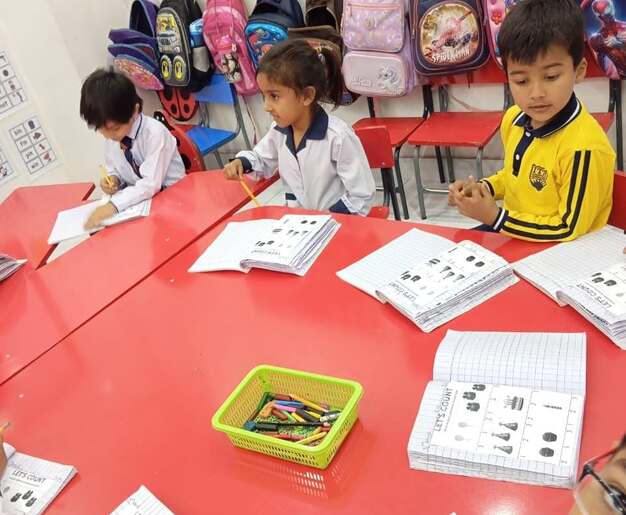
STEAM education for children in the early years does not look like a university laboratory. In Pre-Nursery and Nursery, it takes the form of purposeful, guided play — exploring how water moves through different containers, building with blocks, or creating simple colour patterns. These are not arbitrary activities; they are designed to develop foundational science, mathematics, and spatial reasoning in ways that feel natural and joyful to very young children.
By Grades 3, 4, and 5, STEAM learning becomes more structured, involving documented experiments, collaborative design challenges, and more complex analytical reasoning. The goal at every stage is to make learning active and investigative rather than passive and receptive. This connects closely with the play-based learning approach ITH School has built into its early years programme.
How ITH School Integrates STEAM Into Its Curriculum
At ITH School, STEAM is embedded in the curriculum from Pre-Nursery through to Grade 5. The school’s approach combines the best of Oxford and Cambridge educational frameworks — implemented within Pakistan’s Single National Curriculum — with STEAM principles, Activity-Based Learning (ABL), and Accelerated Brain Learning (APL) methods. This means children meet national learning standards while also developing the thinking skills that genuinely equip them for secondary school and beyond.
The innovative facilities at ITH School — including a dedicated computer lab and purpose-built learning spaces — support the practical, hands-on dimension of STEAM learning. The school also integrates a Learning Management System (LMS) so that teachers and families can track curriculum progress clearly. More detail on how technology is woven into every year group is available in our article on technology integration at ITH School.
Why the “A” for Arts Makes STEAM Complete
Many parents ask why Arts is included alongside Science and Mathematics. The reason is entirely practical: in the real world, engineers design things that must also look clear, function elegantly, and communicate intent. Scientists present findings that require precise language. Technology products are built at the intersection of function and user experience. Children who develop creative and expressive skills alongside analytical ones are better equipped for the complexity of modern professional and civic life — including within Pakistan’s growing technology and design industries.
Common Parent Questions About STEAM
Is STEAM only for children who are naturally good at science or maths?
No. The Arts element is specifically designed to ensure that creative, expressive children are equally engaged. STEAM is genuinely for every learner across every learning style.
Does STEAM mean traditional subjects are dropped?
No. Core literacy, numeracy, and subject knowledge remain central. STEAM shapes how those subjects are taught, not whether they are taught.
At what age should STEAM learning begin?
STEAM principles can be applied meaningfully from Pre-Nursery. At that stage, they take the form of guided play and sensory exploration. Visit our Academics page to see how this unfolds across every year group from PG to Grade 5.
STEAM education for children is not a trend — it is a response to what young learners genuinely need to thrive in an increasingly complex world. To see our full curriculum approach or arrange a campus visit, explore what makes us a top private school in Lahore.
At ITH School, we believe every child deserves an education that builds both knowledge and capability. To learn more, visit our Academics page or reach us via Contact Us or WhatsApp. Follow us on Facebook, Instagram, LinkedIn, and X (Twitter). Visit us at 01 Block A, Chaudhry Road, KCHS Phase 1, Defence Road, Lahore — Location.