

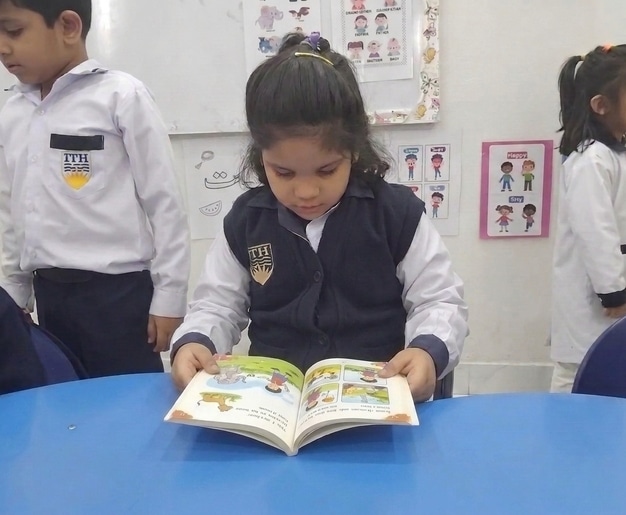
Building a reading habit in children strongly supports long-term educational success. Regular reading improves vocabulary, comprehension, critical thinking, and mathematics. Yet for many families in Lahore, establishing a genuine reading habit at home proves difficult. Children who are eager at first lose interest quickly, or only read when it is assigned as homework.
This guide offers practical, realistic strategies for turning reading from a chore into a genuine part of daily life — starting from Pre-Nursery age and building through primary school. It connects naturally to the home learning tips for parents during holidays that many families find useful during school breaks, when reading continuity matters most.
Why is a Reading Habit in Children a Matter?
A common parental misconception is that once a child can decode words fluently, the reading problem is solved. It is not. Decoding is a skill; reading regularly for meaning and pleasure is a habit. These are different things. A child who can read competently but chooses not to will still fall behind a child who reads less fluently but reads voraciously. Habits compound. The child who reads for 20 minutes every day accumulates tens of thousands of words of exposure each month — words, sentence structures, facts, and ideas that a non-reading child simply does not acquire.
This is why early childhood education that cultivates a love of books and language — rather than simply drilling phonics — produces better long-term reading outcomes.
Start With Being Read To — Not With Reading Independently
For children in Pre-Nursery, Nursery, and KG, the goal is not independent reading. The goal is building a positive, emotionally warm association with books and stories. Being read to by a parent is the single most effective thing a family can do to lay the groundwork for a strong reading habit in children.
Read aloud every day — even five minutes counts. Use expression, pause at interesting moments, ask simple questions like “What do you think happens next?” Make it a moment of connection, not instruction. Children who grow up being read to enthusiastically develop not just vocabulary and comprehension, but a genuine appetite for stories.
Build a Book-Friendly Environment at Home
Children read more when books are visible, accessible, and associated with pleasurable moments. Practical steps for creating a book-friendly home include:
- Keep books at child height in a designated area or basket
- Visit the library together — borrowing a book a child chooses themselves creates ownership and motivation
- Let children choose — within age-appropriate boundaries, allow children to select their own reading material
- Have books in more than one room — a bookshelf in the bedroom and a basket of books in the sitting area both normalise the presence of reading material in daily life
- Display books face-out rather than spine-out — young children choose books based on covers
Connect Reading to Your Child’s Specific Interests
A child who has no interest in fiction might be captivated by books about animals, vehicles, science experiments, or sport. Following a child’s curiosity builds reading interest and habits better than insisting on specific genres. Reading dinosaurs develops the same skills as reading classics.
This connects to the broader principle that children engage most fully when their natural interests are respected — something explored in our post on why children get bored at school and what that tells parents about learning engagement.
Establish a Reading Routine — and Protect It
Habits are built through consistency, not intensity. A 15-minute reading session at the same time every day — before bed is the most reliable slot for most families — is dramatically more effective than occasional hour-long reading marathons. Set the routine, protect it from displacement by screens and other activities, and maintain it even on days when neither you nor your child particularly feels like it.
The screen time question is relevant here: families that set clear boundaries around screen time for kids after school typically find it much easier to establish and maintain a reading routine, because screens and books compete directly for the same evening time.
Model Reading Yourself
Children imitate what adults around them do, not what adults tell them to do. If children never see adults reading for pleasure, they may view reading as schoolwork. Simply read beside them to make reading part of life.
What to Do When Your Child Resists Reading
Resistance is normal, particularly in the early stages. Start with short sessions, offer choices, read together, and connect books to children’s interests. Avoid using reading as punishment or screen-time leverage.
At ITH School, our library and reading-enrichment approach is part of how we support lifelong learning in every student. To learn more about our academic programmes, visit our Academics page.
At ITH School, we believe reading is the foundation of everything. Reach us via Contact Us or WhatsApp. Follow us on Facebook, Instagram, LinkedIn, and X (Twitter). Visit us at 01 Block A, Chaudhry Road, KCHS Phase 1, Defence Road, Lahore — Location.